
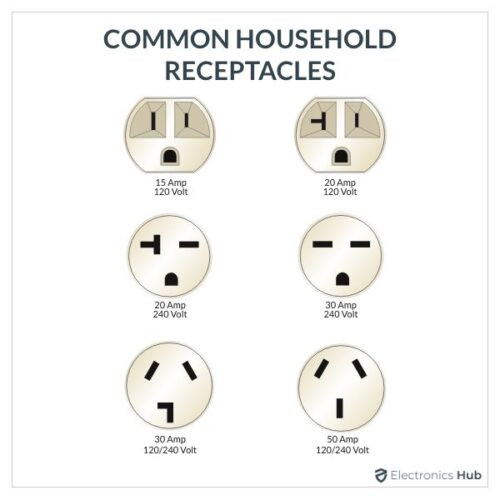
These outlets are the ones you’re most likely to have in your house.
Ok, so let’s talk about the types of outlets you’ll find in your house. For the most part, you are going to see 120 volts, 15 amp, and 20 amp. And 220 2-wire, 3-wire, and four-wire types.
Please remember not all 220-volt outlets use a neutral (white) wire. To give you a general idea, let’s say you just bought an air compressor from Home Depot. It requires 220 volts but the plug only has three prongs. You’ll have the two that look alike and will be the two separate hots and the other round looking on would be the ground. And of course, more than likely it would be 20 amp.
220 volts 20 amps

This is a 220v 20 amp outlet as shown in the how-to 220-volt outlet video likely to be used for larger power tools in your garage or shop or perhaps a wall air conditioner.
220 volts 30 amps

Wire Connections for X Y W 240 Volt Receptacle Dryer Outlets The Black Wire attaches to Outlet Terminal X The Red Wire attaches to Outlet Terminal Y The White Neutral or Green wire or Ground wire attaches to Outlet Terminal W
Commonly known as a dryer outlet. Of course, used for a clothes dryer. This would be used in a wall box with a cover plate (flush mount)
220 volt 50 amp outlets

In a house, these would be considered the big boys. You’ll find one of these in newer homes for a stove-oven combo. This is a 4-wire outlet. See my video on how to install one of these. This is a 50 amp 220 4 wire. Better known as a stove or oven outlet Keep in mind, although you might have an oven, dryer, stove, or whatever. It may not have an outlet at all. It could be hard-wired into the appliance. And that’s fine, lots of bigger commercial appliances are known to be wired that way. Tip… Red is hot (110 volts), and black is also hot (110 volts) = 220 volts. White is neutral and is the returned path back to the transformer on the road. The ground is just that. Ground to each and is always used on anything electric. Unless of course, your house is very old in which case should be updated just for pure safety.
Surface Mount 220v outlet

This is a surface mount 220v outlet. You would find these in older homes where the installation came after the house was built.
3 wire stove receptacle


Click on the above images to make them bigger
In conclusion, understanding the various outlet configurations in your home is essential for proper electrical safety and functionality. Most residential spaces are equipped with 120-volt outlets rated for 15 and 20 amps.
It’s important to recognize the significance of 220-volt options, including 2-wire, 3-wire, and 4-wire configurations. Familiarizing yourself with these types can help you make informed decisions regarding appliance connections and electrical upgrades.
We invite you to share your thoughts and experiences related to 220-volt plug receptacle configurations in the comments section below. Your insights could be beneficial to others navigating these electrical considerations.
Wire Size Calculator
Use this calculator to help you determine what size wire to use.


Comments ( 88 )
Hi, I am in AUS and have a 220v hydraulic power unit. It has three wires, Red/Black/Yellow on Green.
How do I get this to work as we have 240v mains supply here?
Here in the USA red and black would be a leg of each hot 120 v each. Doesn’t matter which one goes where. Yellow and green would be a isolated ground.
Hi, I have a 3/4 HP Water pump set a 220 by the lake to feed my cottage.Currently the pump is wired directly to my panel.I would like to put in a on/off switch in my Bunkie adjacent to the pump.Are there considerations for what type of 220 switch and receptacle?
use a twin pole switch. This will have 4 screws / connections not including the ground.
Don’t know if anyone is monitoring this website, but I would like to know WHICH 220v plug configuration to install in my garage, not knowing what receptacle I will need in the future?
This all depends on what you’re intending to hook up.
Hi, I just moved into a house that has a 4 wire plug like the ‘big boy’ you show here. My dryer has the regular 220 20amp plug. Do I need an adapter or to convert the whole recepticle and run a lower amp connection?
Your dryer should be a 220 30amp. You should need to change the outlet or the power on your dryer.
I have a 240 volt 15 amp air compressor. Can I change the plug and get it to run on a 240 volt 30 amp dryer receptacle?
Sure like a dryer. Yes, you can, but if something in the compressor shorts out it will be protected by 30 amps. That compressor with be toast
Will a 50 Amp. 3 prong plug fit into a 50 Amp 4 wire female receptacle? (Same grd. configuration?)
One has 3 connectors and the other has 4. So no it won’t.
I have a pump and float switch with a 2-wire + ground 230v plug (NEMA 6-16). Can I make an adapter so I can run this from a 120v generator using two plugs?
If not, can I make an adapter to run the pump from a generator with a 3 wire + ground 230 plug?
Thank you
Yeah sure you can from the 220-volt outlet side of the generator
Thank you.
Dear Mr/Mrs
Thanks for your website .I need electrical code for preparation myself in 309A exam as far as I got my temporary licence in electrician field.
Best Regards,
Peyman,
I just bought a new home, and the washer and dryer needed to be replaced. We checked the back of the dryer prior to purchase to confirm there was a gas line (old one was electric on a 220V line). What I missed, is that there was only one 110V receptacle on the circuit in the area behind the washer and dryer. I have my dryer hooked up fine, with the exception that I have a temporary extension chord running to a nearby outlet.
So, im trying to look into converting the 220 to 110 … or maybe change out the single 110 to a double 110 receptacle GFCI.
Any guidance on changing to the 220 receptacle to a 110V for the dryer? Or, would you recommend leaving it alone and changing the 110 (with one receptacle) to a 110 with 2 places to plug in?
FYI – I checked the rating on the washer and dryer, they are 10A for the washer and 6A for the dryer … so I think a combined 16A should be good on the 20A circuit if I decided to plug in both into the existing 110 (after adding the 2nd plug to it).
My first thought was to change the 220 to 110 … any guidance you can provide?
Really I would just bring another 110 volt outlet to the dryer. Playing with the existing 220 would not be wise.
So, use the existing 110V circuit and change out the single plug outlet to a dual plug outlet? Or are you saying to run another line from the breaker box?
Run another line.
Ok. I have an appliance that is requiring 220. The plug is 3 wire, white, black, and ground. I have a 60amp double stack available and ran 10/3 to a receptacle that has 3 wire set up. My black is on just one side of the 60 double stack. Matched the wires going into the receptacle with plug. Powers up fine, but not getting the volts I need. Is this because I am not getting 220 from the double stack by only using one side. Should I replace the double stack 60 with a single stack 30? Let me be clear, I am not an electrician but handy. I have hooked up a 50 amp and 30 amp rv plugs with no problem. Thank you all
Ok, please watch my videos on installing a 220 volt outlet. Everything will much clearer for you. There is no such thing as a double stack. It’s two pole. Meaning that each leg is going to grab a separate hot from the panel, each one being 120 volts =220/240 volts. Your black is 120, now your white will become 120 each.
Hello,
I have a generator rated at 220 volt 30 amp on one outlet. Should I expect to have 30 amps on each hot leg, or 15 amps each for a total of 30 amps? The specs do not not indicate anything either way.
Thank you
Yes, 15 amps pm each leg for a total of 30 amps.