
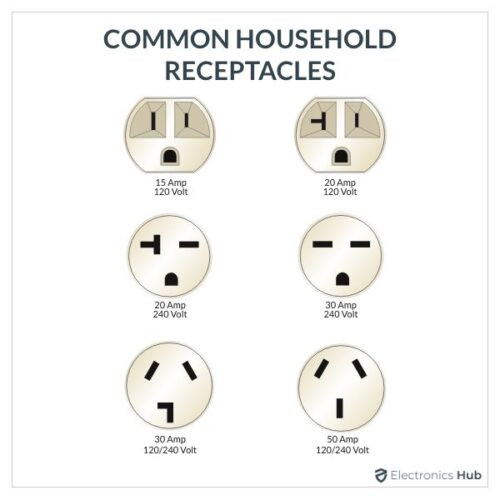
These outlets are the ones you’re most likely to have in your house.
Ok, so let’s talk about the types of outlets you’ll find in your house. For the most part, you are going to see 120 volts, 15 amp, and 20 amp. And 220 2-wire, 3-wire, and four-wire types.
Please remember not all 220-volt outlets use a neutral (white) wire. To give you a general idea, let’s say you just bought an air compressor from Home Depot. It requires 220 volts but the plug only has three prongs. You’ll have the two that look alike and will be the two separate hots and the other round looking on would be the ground. And of course, more than likely it would be 20 amp.
220 volts 20 amps

This is a 220v 20 amp outlet as shown in the how-to 220-volt outlet video likely to be used for larger power tools in your garage or shop or perhaps a wall air conditioner.
220 volts 30 amps

Wire Connections for X Y W 240 Volt Receptacle Dryer Outlets The Black Wire attaches to Outlet Terminal X The Red Wire attaches to Outlet Terminal Y The White Neutral or Green wire or Ground wire attaches to Outlet Terminal W
Commonly known as a dryer outlet. Of course, used for a clothes dryer. This would be used in a wall box with a cover plate (flush mount)
220 volt 50 amp outlets

In a house, these would be considered the big boys. You’ll find one of these in newer homes for a stove-oven combo. This is a 4-wire outlet. See my video on how to install one of these. This is a 50 amp 220 4 wire. Better known as a stove or oven outlet Keep in mind, although you might have an oven, dryer, stove, or whatever. It may not have an outlet at all. It could be hard-wired into the appliance. And that’s fine, lots of bigger commercial appliances are known to be wired that way. Tip… Red is hot (110 volts), and black is also hot (110 volts) = 220 volts. White is neutral and is the returned path back to the transformer on the road. The ground is just that. Ground to each and is always used on anything electric. Unless of course, your house is very old in which case should be updated just for pure safety.
Surface Mount 220v outlet

This is a surface mount 220v outlet. You would find these in older homes where the installation came after the house was built.
3 wire stove receptacle


Click on the above images to make them bigger
In conclusion, understanding the various outlet configurations in your home is essential for proper electrical safety and functionality. Most residential spaces are equipped with 120-volt outlets rated for 15 and 20 amps.
It’s important to recognize the significance of 220-volt options, including 2-wire, 3-wire, and 4-wire configurations. Familiarizing yourself with these types can help you make informed decisions regarding appliance connections and electrical upgrades.
We invite you to share your thoughts and experiences related to 220-volt plug receptacle configurations in the comments section below. Your insights could be beneficial to others navigating these electrical considerations.
Wire Size Calculator
Use this calculator to help you determine what size wire to use.


Comments ( 88 )
Ok, thank you.
I have an oven (not too old: 15 years old) which has the same plug as the one that fits into the 220volt 50 amp outlet, but the house is old and I bet that doesn’t have 4 wires. At the wall, I have an outlet similar to the one listed under the 220 volt 30 amp.
Can I change either the outlet or the plug to match?
No, you’ll need either a 40 or 50 wire and plug. Or just hard wire to the stove. It’s the wire and the breaker you’ll want to pay attention to.
I replaced a 3 wire wielder outlet in our shop. Two legs are 110 and one is neutral. When tested. Each leg is 110 to the neutral and to the grounded metal box. Plugged into the two hot terminals reads 220. Plug in the wielding machine and I get nothing. The machine runs fine on the other 220 outlet connected to the same 50 smp breaker 30 +/- feet away.
This should be a piece of cake. It has the old 3 wire system… not rocket science. I didn’t run a new line, just used the one there. Everything seems to check, but still the wielder does not work… not even dull light or flickering.
What have I missed or done wrong?
Gee sounds right to me. Seems like tome you just have the outlet wired wrong. I would double triple check that.
I have a question pertaining to a circuit’s amperage. I have a dedicated 240v/50amp circuit for a car charger. The recent PHEV we leased has the capability of accepting standard 120v or 240v input however the plug configuration is a 240v/20amp design. Can I simply rewire the receptacle to match the 240v car plug or will this be dangerous?
Yes of course that’s fine. Just make sure you connect the correct wires correctly. Hot with hot, ground with ground
I did not know that 220 outlets/cords have different type of configurations. I bought a 24 inch electric stove for my tiny kitchen. I was so excited to finally have an oven and the price was perfect. But alas, the cord has a different shape then the outlet even though both are 220. Are adaptor plugs available in these kinds of situations and is it safe to use an adaptor plug? No matter how cute the stove, I prefer not to burn my house down. :P Thanks so much.
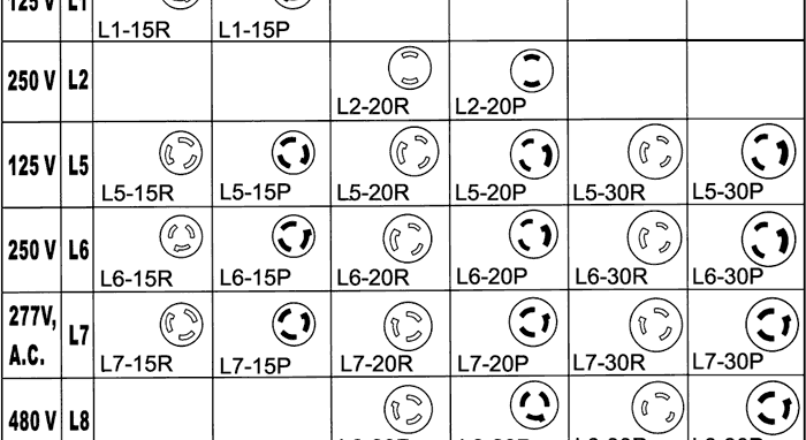
Looking for male plugs for 220 volt receptacle with external lip on the neutral/ground terminal. These are hubbell or leviton receptacles. The only kind there are, are the internal lip on the plugs. Was wondering if L7 20P, L8 20P or L9 20P plugs( which are 480 volt plugs) will work on my 220 volt, 20 amp receptacles.
Just found a Sony tv but was not aware that it is 220 volts! Can I just buy an adapter and plug this in to a standard USA outlet? Or do I need to have the outlet changed to accommodate the 220 volts?
If it really is 220 volt then no. You need 220. But really a 220 volt TV?
In your videos, you talk too fast for me to follow and kind of mush some of your words together. Rather than “laid-back” I’d prefer professional.
20 million views and you’re the first one to ever say that. I’ll keep that in mind, thank you.
Can you put two 220 plugs on one wire
No, you should not.
Dryer is dead. Circuit is not tripped. Checked outlet and have hot indications at 2 of the 3 prongs. Is this normal? Trying to eliminate issues before calling for repairs.
Outlet seems fine.